Eva Ras and the importance of documenting your scene
"This music is not just noise. It’s a document of a society and a person breaking apart."
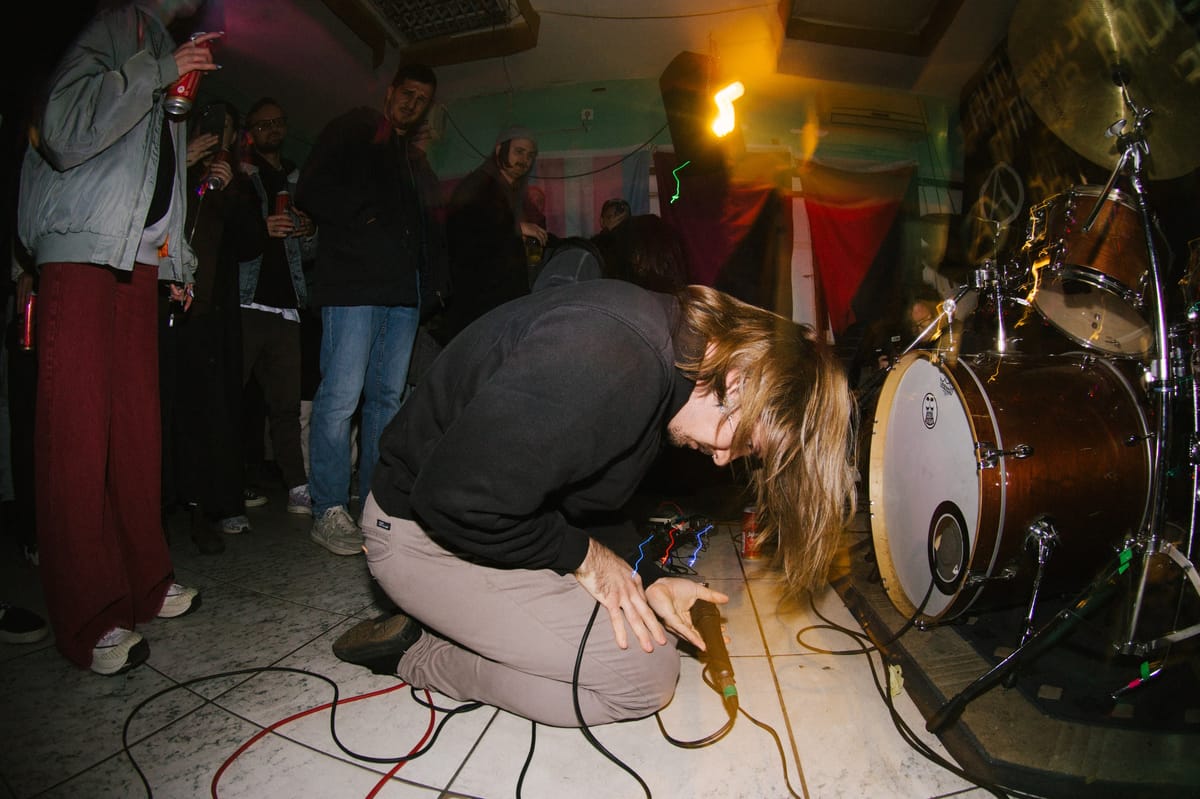
MOJE IME, MOJ DOM I MOJ TERET*, the 2025 album by Belgrade’s Eva Ras, exists with the explicit intention of preserving history. Filip Stojiljković, the man behind the solo project, recounts: “Eva Ras was born in the spring of 2016, at a time when I felt a mixture of political exhaustion, emotional instability, and an urge to document what was happening around me.”
The album’s cover presents a timeline of violence and rebellion from the former Yugoslavia. It shows the 1968 Belgrade student revolution, Slovenian partisan and Nazi-fighter Albina Mali Hočevar, and the execution of leftist Stjepan Filipović** as he screamed "death to fascism, freedom to the people.” On the first track, a soundbite of Slavoj Žižek plays where he sarcastically describes the “geographical limit” of the Balkan region, thus introducing the album's exploration of the region's history before the music even starts.
“The samples are the spine of the album,” Filip explains, and it’s true - not only does MOJE IME, MOJ DOM I MOJ TERET serve as a cathartic powerhouse, by embedding this history within itself, it makes sure that that history is never lost.
The need to create and maintain archives is a key driver for Filip’s various projects. Not only does he cover Belgrade music news, he also runs the blog XDekonstrukcijaxYugoviolenceX, a blog that seeks to compile a list of every screamo band from the region - I just discovered Montenegro's Theft of October through the blog, and their 2013 self-titled demo EP would have fit right into my high school playlists next to Circa Survive.
Filip and I exchanged emails about the Eva Ras project and the importance of archiving. Here is an excerpt of our conversations.
Tell me a little bit about yourself and the project.
My name is Filip Stojiljković, I’m from Belgrade, Serbia, and I’ve been making music for more than a decade now. I started in 2013 with harsh noise and experimental projects like WAAS, and over the years moved through different identities, Sueisntfine, FreeClickTm, Stevo Žigon, etc.
Since then, I’ve also become involved in other bands - Art of Heartwork and Tužan Dečak Kavr Bend - but Eva Ras has always been the project where I process the world most directly. It's the one that grew with me, hurt me, and eventually exhausted me.
Why did you choose to name the project after the actress Eva Ras?
I get this question a lot, and the truth is: the name came from an instinct that I only learned to understand years later.
Eva Ras is a Serbo-Hungarian actress best known for her roles in the Yugoslav Black Wave, a movement that was censored, attacked, and pushed into exile. There was something about that fragility, that sense of being unwanted and misunderstood, that resonated deeply with what I was feeling when I started the project.
The name carries melancholy, vulnerability, and a kind of cultural loss. It’s an identity that feels unstable... a blank, trembling space trying to survive authoritarian pressure.
In a way, choosing her name was my way of saying: this music is not just noise. It’s a document of a society and a person breaking apart.
I also wanted to know more about the Dekonstrukcija Yugoviolence blog project before we dig into your album. What made you want to start the webzine? How do you find albums to highlight?
The Dekonstrukcija Yugoviolence blog started as an extension of a list I made on RateYourMusic. I didn’t want these bands - many of them obscure, forgotten, or misunderstood - to exist only as names in a database.
The region has a complicated relationship with screamo, emoviolence, and underground culture, and I felt that documenting these releases in depth was necessary. Writing about them was a way to resist cultural erasure. I also felt that there are often not enough people to document this scene, so I ended up taking on that role because I didn't want to leave a void behind.
In the blog, I go through discographies, reflect on their sound, highlight my favorite tracks, and try to frame the releases in a historical context. My inspirations are blogs like Open Mind Saturated Brain, Sophie’s Floorboard, and Natures with No Plagues, all spaces that treated emotional hardcore with respect and seriousness.
My aim is simple: to give these records the attention they never received.
You mention documenting and archiving the region with these songs and with the blog. It makes Eva Ras feel like a living archive. Does this desire to capture / archive drive a lot of your artistic endeavors?
Yes. I think most of what I do is driven by a fear of disappearance. Scenes here collapse fast, bands break up, releases vanish, and nobody documents anything. Eva Ras started as a musical project, but over the years it became a kind of personal archive, an attempt to preserve the emotional and political landscape of this region before it dissolves. If the West gets to keep its history, then so should we. Someone has to record what happens here, even if it’s ugly.
As for the album itself - were there other collaborators on the album, or is it all just you?
It’s entirely me. Eva Ras has always been a solo outlet, not because I’m against collaboration, but because this project demands a kind of raw, uninterrupted emotional and political honesty that’s easier to maintain alone. The chaos, the noise, the urgency… it works best when I don’t have to negotiate it with anyone.
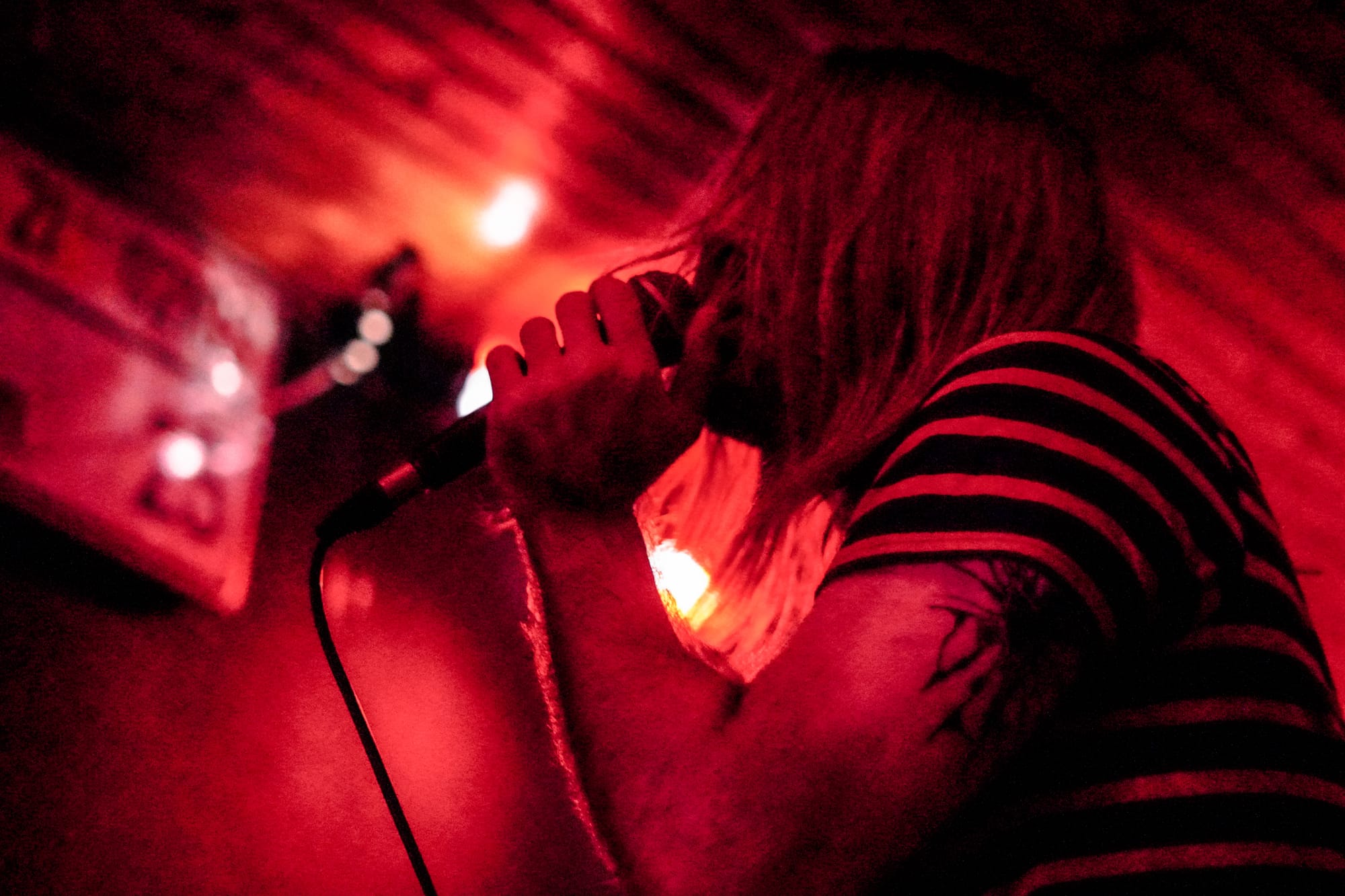
I especially wanted to ask you about the samples on this album. That opening sample is so jolting, and it immediately sets the context for all the anger in the music that follows. Can you tell me about all the samples? Why Daisies, why Uncle Vanya, etc?
The samples are the spine of the album. The Žižek excerpt (‘The Spectre of Balkan") sounds absurd at first, but it reveals a very real pathology: every nation in this region pushes the label "Balkan" onto someone else, as if the rot is always further down the map. It’s a perfect snapshot of how nationalism works here: denial, projection, and contempt for whoever is "below" you.
Daisies is there because that one line ("Rehabilitation center? Die, die, die!") captures the same authoritarian arrogance... leaders who would rather let everything burn than fix anything. And Sonya’s breakdown from Uncle Vanya mirrors the emotional collapse felt in this country: exhaustion, hopelessness, hysteria. Every sample reflects another dimension of living under systems that are falling apart.
I also wanted to ask about, “O ČEMU JE PROBLEM?” and “THE PROBLEM IS…” - I love the glitchy chopped up sample effects and I love the way those songs are sequenced on the album. Where is this sample from? Why did you want to include it?
Those two tracks are a pair. One is [President of Serbia, Aleksandar] Vučić being openly mocked by the public, the other is [prime minister of Hungary, Viktor] Orbán collapsing into incoherence before blurting out, “the problem is the war!”. Both represent leaders who have lost legitimacy but still cling to power. I wanted these tracks to feel glitchy, broken, unstable, like the regimes themselves. They’re not songs, they’re ruptures. They divide the album the same way these men divide our countries.
You said this would be the last Eva Ras project, do you know what you want to do next?
Yes, this is the final Eva Ras release. Not because I ran out of ideas, but because the project reached its natural ending. I said everything this name was created to say.
I’ll still finish the remaining Zapis installments, which are more like a parallel diary to this album. And after that… I want to start something new from zero, without the weight of this decade-long narrative. Eva Ras documented a specific era. Whatever comes next should belong to a different one.
If there’s one thing you hope people learn from the album / this project, what is it?
If people take anything from this project, I hope it’s the understanding that you can’t wait for perfect conditions to create something honest. Places disappear. Scenes collapse. Countries rot in real time.
If you don’t document your reality now, it will vanish... and you’ll vanish with it.
So whatever you feel, whatever you witness, whatever hurts: respond immediately. Don’t wait for the “right moment.” Create now, even if it’s messy.
Especially if it’s messy.
Filip recently debuted the documentary short FAREWELL AKAB OKRETNICA, which covers Belgrade’s now shuttered anti-nationalist venue AKAB Okretnica. Keep an eye out for it, and follow its Instagram here. You can follow Filip here, and support MOJE IME, MOJ DOM I MOJ TERET on Bandcamp here.
*title translates to “my name, my home and my burden”
**Filipović is also pictured on Croatian band frontalni udar's album kaptializam mrzi me.